IGait

Author name: admin

MATERIAL HANDLING PRODUCTIVITY SOLUTIONS

Material handling can be defined as the movement , protection and storage of materials. One of the main reasons for low productivity is the time & effort of the workers involved in transporting, positioning and handling the garments. By use of proper material handling, the productivity can kickstart to a new level. l. Material handling equipment are required for transportation, positioning equipment, unit load equipment and for storage & warehouse. Transportation equipment is required to move goods from one place to another. The positioning equipment is required to position the goods in such a way that production can be done effectively. Unit loading is required to consolidate several parts into one unit and for moving around like bundles etc.. Storing and warehouse is another important area that the IE must focus on for improvement. Latest technologies and affordability are available in areas of storage and in line along with automatic rfid/ barcode systems. Instead of going for ready made solutions, developing customized solutions for movement of materials from one floor to another is very useful.

MATERIAL HANDLING PRODUCTIVITY SOLUTIONS Read More »
OPERATIONS RESEARCH APPLICATION IN GARMENT INDUSTRY

Operations research is the science of solving problems by developing a sample/mathematical model of a problem and using such sample/model simulation to solve the problems. Practical examples are line balancing , material planning, demand planning, capacity planning, supply chain management, digital integration of supply chain etc. for example planning has to be balanced with available capacity, demand for the product, material availability etc., Normally capacity planning is calculated on the basis of SAM/SMV available and existing efficiency.Material planning on the basis of past data and vendor details.

The problem is converted to a math problem by certain assumptions and then applies mathematical/simulation models like linear programming, assignment problem, queuing theory, transportation problems, game theory to solve problems to solve problems and develop better systems and procedures. Various simulation software are also available to simulate a problem virtually and arrive at solutions. Such models can be used in areas of line balancing, plant layout, process layout , machine lay out etc., Linear programming….., heuristic. The incremental utilization heuristic( trial & error) helps to solve the problem in simulation and apply the same in reality. An important advantage of this heuristic (trial & error) simulation is that it is capable of solving line-balancing problems regardless of the length of task times relative to the cycle time.

OPERATIONS RESEARCH APPLICATION IN GARMENT INDUSTRY Read More »

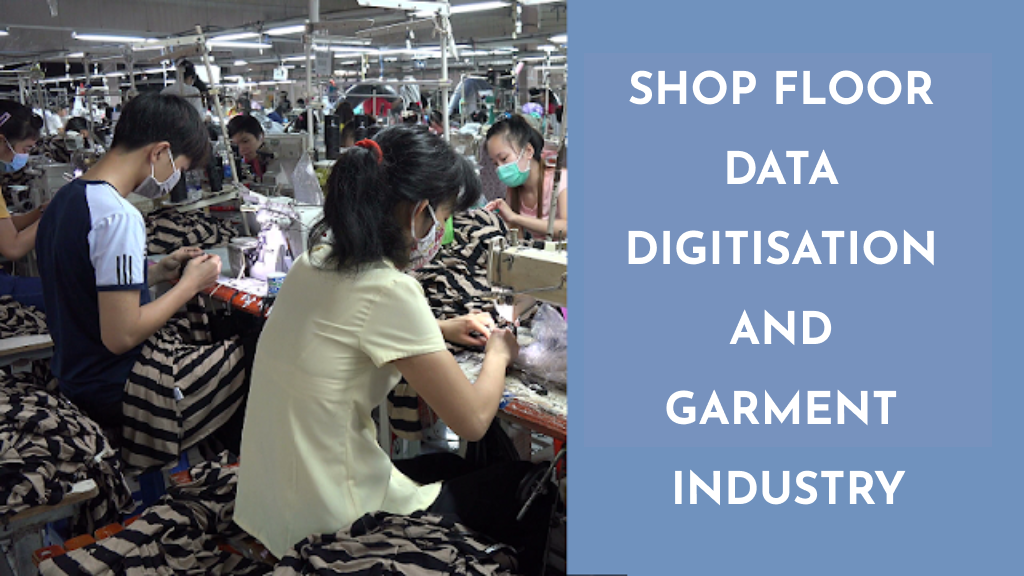
SHOP FLOOR DATA DIGITISATION AND GARMENT INDUSTRY

  • Normally the wip movement and operators working are taken note in pen and paper and later this data is converted into whiteboards or into excel sheets for further actions. Many a times these data are not accurate leading to wrong decisions and loss of production efficiency. With the present digital technology, we can digitize the data at the source of collection and obtain real time information and MIS reports.

  • Managing and improving productivity needs to effectively use the resources manpower, machines etc, and the main problem is all these absenteeism, skill levels, material availability are all variables and without proper data,the efficiency drops. Proper planning about the machine capacity, operator capacity, skill levels, operation details, requires real time data for better analysis and decision making to fix scientific data and for all this shop floor needs data to analyze and improve. Unlike in the past, in todays world data collection of data digitally and analysis is much easier and cheaper.

  • Most of the garment factories record the shop floor data in pen ,sheets and notebooks. This information is then used for display boards on the factory and preparing exel sheets and MIS reports. Most of the data is delayed and not reliable , so much so the users are not able to effectively use them.

  • Digitisation of data requires that, instead of pen and paper, shop floor data is captured digitally through things like tablets, rfid, barcodes, and other electronic systems, at the source and almost on real time.

Some of the advantage of digitization are:
Improved production processes, leading to huge improvement in efficiencies.

  1. Real time information to act on production, compared with manual reports which are delayed and most of the time interventions can’t be done.
  2. All these dates are available to make MIS reports ,which help the management to take corrective actions and analysis.
  3. Long term trends and comparisons can be done as the data is available for several years.

SHOP FLOOR DATA DIGITISATION AND GARMENT INDUSTRY Read More »

PRODUCTIVITY OF THE BOTTLENECK TOC (theory of constraints)

For any solution we must know the real cause of the problem. garment factories work on the principle that the overall efficiency / productivity can be increased by increasing the individual operator /operation efficiency. To this end each operator is provided with a buffer/wip of pieces, so that operators’ time is not wasted while waiting for pieces.. However in the concept of TOC, as established by Mr.Elia hu Goldratt; the efficiency of the factory depends on identification and improvement of the bottleneck. The following table can explain the difference between TOC model in comparison to the normal model


Comparison Table of  TOC MODEL  &  CURRENT PRODUCTION MODEL
TOC MODEL
  1. PRODUCTIVITY OF THE LINE DEPENDS ON THE BOTTLENECK.
  2. DATA IS ESSENTIAL TO FIND OUT THE BOTTLENECK AND ANALYZE METHODS ASSUMED THAT THE OPERATORS PRODUCE AS PER THEIR CAPACITY, BUT IN REALITY THE SITUATION VARIES DEPENDING ON MACHINE PERFORMANCE, MATERIAL AVAILABILITY ETC. AND HENCE THE NEED FOR REAL TIME ANALYSIS.
  3. System push: System in contrast to the push system. Push system is where the wip is increased to put a pressure on the operators to perform, whereas pull system is to ensure sufficient, but not more to create a push. Instead sufficient so that everyone has sufficient for production Focus on bottleneck PROBLEMS
  4. PLANNING: Requires detailed info on various capacities and the bottleneck and takes little time but systematic, being a pull concept production is smooth and easy
  5. BALANCING THE FLOWS AND NOT CAPACITY
  6. UTILISATION OF RESOURCE: Only the existing constraint/bottleneck
CURRENT PRODUCTION MODEL
  1. PRODUCTIVITY ON THE LINE DEPENDS ON BALANCING THE LINE WELL.
  2. SINCE IT IS ASSUMED THAT OPERATORS  MORE OR LESS PRODUCE THE SAME AS  PER THEIR CAPACITY, THERE IS NO FOCUS ON REAL TIME DATA COLLECTION. However in reality the production of each individual  depends on machine performance, fatigue, mental and emotional status, wip availability etc.
  3. System push: System is where excess is pushed into the system so that higher production can be achieved Focus is on each individual operations to achieve individual targets and line balance
  4. PLANNING: Can start the line without much difficulty, but needs to focus on several areas continuously and push them. Requires constant intervention and motivation
  5. BALANCING THE CAPACITIES
  6. UTILISATION OF RESOURCE: Every resource should be used to the maximum extent
  • The Goal of any organization is to earn money and share it with the team and the method to achieve this goal requires a good organization and system and whatever is blocking this goal is the constraint.
  • The identification and management of the constraint/bottleneck is the concept of TOC.
  • The normal production concept applied in the garment industry is to make each department and each worker more efficient, so that the overall efficiency increases;
  • In contrast the concept of TOC, is to first analyze and identify the bottleneck operation and then focus on improving the bottleneck operation.

PRODUCTIVITY OF THE BOTTLENECK TOC (theory of constraints) Read More »

LATEST CONCEPTS IN INDUSTRIAL ENGINEERING & FOR COMPETITIVE ADVANTAGE LONG TERM SUSTENANCE

The object of this blog is to explore methods for garment factories to have competitive advantage for long term sustenance. Unlike some industries which have patented technologies and special rights over resources; the garment factories have to look at improved efficiency for competitive advantage. Industrial engineering is the study and application of a wide range of latest technologies in production improvement. In the context of Garment/apparel factories and in the fashion industry, Industrial Engineering concepts like time study, method study, line balancing ,skill matrix etc., for production planning, control & improvement are widely used and prevalent.

COMPETITIVE ADVANTAGE: Businesses have to develop their competitive advantages and abilities to sustain on the longer run. In this blog we will discuss certain latest concepts that can increase the ability of organizations. However worldwide concepts like debottlenecking TOC;shop floor data digitisation, operations research, workstation ergonomics design improvements,, material handling, factory layout designs, energy management, quality engineering management, lead time improvement, sewing operation standardization & digitisation,etc., are some of the areas which has huge potential for productivity and profitability. In this blog, we will discuss the salient features of the lesser used, but highly beneficial concepts.

FOR MORE DETAILS……………………….GO TO ANOTHER PAGE, AND INFORM PLS GIVE YOUR MAIL ID TO SEND ALL THE COMPLETE DETAILS

LATEST CONCEPTS IN INDUSTRIAL ENGINEERING & FOR COMPETITIVE ADVANTAGE LONG TERM SUSTENANCE Read More »